Original document available here: eATA Global Transition Plan (GTP).
Moving from a paper-based document to a digital procedure
Current Version: April 2026. First Version: November 2022.
Summary of major updates:
- Customs administrations are encouraged to accept paper ATA carnets until the end of the transition phase, i.e. 31 December 2027, when digital declaration, i.e. QR code, would not be available.
- From 1 June 2026, no new NGA members will be accepted into the ATA guaranteeing chain if they are not able to issue digital carnets.
TABLE OF CONTENTS
- Moving from a paper-based document to a digital procedure
- Background
- Summary of the concept
- Overview of the ATA Carnet System architecture
- Comparison of ATA paper process and the full digital process
- How do ATA Carnet stakeholders go fully digital
- Assumptions of this paper
- Different use cases during the transition phase
- Extended scenarios
- Principles towards the global transition
Background
The ATA Carnet is an international customs document that permits duty-free and tax-free temporary import of goods for up to one year. It contains pre-prepared unified customs declaration forms to be used at each customs border offices and serves as a guarantee to customs duties and taxes. The initials “ATA” are an acronym of the French and English words “Admission Temporaire/ Temporary Admission.”
The ATA Carnet was created in 1960’ as a paper-based document, but its digitisation (turning the physical paper into an electronic file) and the digitalisation of the Carnet-based temporary admission process has been discussed since 2007. The fact is that, given the complicated nature of temporary admission and the complexity of the data exchanges taking place among the various parties involved (ATA Carnet holders and representatives, issuing associations, national guaranteeing associations and Customs authorities), the task has proven to be challenging. The digitalization of the process must be done at an international level in an organized and coordinated way.
The eATA Carnet project aims to digitalise ATA Carnets and their lifecycle management process – from issuance and declarations to transactions and claims. ICC first developed its eATA concept in 2016. With the support of the World Customs Organization, a pilot project was launched to move from academic research to development and implementation. A brand-new ATA Carnet system (eATA carnet system) was made available by ICC, comprising various digital tools tailored for a range of stakeholders.
The system has been tested in selected pilot countries since October 2019. Based on the feedback of pilot participants, the system underwent massive enhancement and its official production version (1.0 release) was launched in July 2023. From that moment, the eATA Project was transformed from its pilot phase to the global transition preparation phase.
Contracting Parties are invited to make necessary preparations accordingly:
- the first group of Customs administrations (European Union, Norway, Switzerland and the UK) are ready to officially accept digital carnets as from 1 June 2026,
- the remaining Contracting parties shift to digital gradually between 1 June 2026 and 31 December 2027,
- the ATA Carnet procedure is expected to be fully digital worldwide as from 1 January 2028.
Based on further analysis and practical/operational considerations as well as feedback from Customs, Chambers and Holders, it is highly recommended to exercise flexibility in the transition phase to ensure a smooth shift of ATA Carnet procedure from paper to digital. For that reason, customs administrations are encouraged to accept paper ATA carnets until the end of the transition phase, i.e. 31 December 2027, when digital declaration, i.e. QR code, would not be available.
In addition, from 1 June 2026, no new NGA members will be accepted into the ATA guaranteeing chain if they are not able to issue digital carnets.
Once the global transition starts, any country ready to adopt the digital procedure should notify both ICC and WCO as described in section 5. There is no need to wait for a second group to participate.
This document is prepared for the WCO ATA/Istanbul Convention Administrative Committee to set up a common strategy to carry out the eATA global transition. The content can be enriched, and adjusted in a living manner through dynamic result analysis.
Summary of the concept
Moving from paper to digital requires a change of mindset. The goal of the project was to digitalise the paper-based ATA Carnet procedure. While mirroring the paper procedure as much as possible, some new elements compatible with what makes sense in the digital world have to be taken into account. The ATA Carnet real-time lifecycle management system (ATA Carnet System) was designed and developed under this direction from the very start.
From an end user perspective, the concept and the new paradigm defined are the following:
- Holder orders carnets online through National Issuing and Claims Systems (NICS), the local systems not part of the ATA Carnet System.
- Holder downloads the ordered carnet into their wallet (ATA Carnet App or ATA Carnet Desktop) and if necessary, shares it with their representative. The carnet is encrypted and never transmitted in ‘open format’ on the network.
- During border crossing, the holder or representative unlocks their wallet and shows a QR code or a transaction code that corresponds to a particular carnet and a specific transaction. In countries where pre-arrival notification/declaration is required, the holder or representative may pre-notify customs about the arrival of goods and with the options to include carnet info for customs to view or transact.
- Customs officer opens ATA Carnet Customs and scans the QR code or types in the carnet ID + transaction code, sees the detailed carnet info, and confirms transactions. For customs requiring prearrival notices/declarations, they may also access carnet info via the portal directly.
- The transaction is recorded, and a confirmation is sent to the holder via ATA Carnet App/ATA Carnet Desktop.
- Customs have the possibility to detect potential claims and eliminate unnecessary claims through virtual voucher reconciliation and manage them with National Guaranteeing Associations (NGAs)
Overview of the ATA Carnet System architecture
Let us look at the technicalities of the ATA Carnet digital ecosystem. The image below provides a general overview of its design and architecture: the system per se is made up of six types of components (Exhibit 1-6). Exhibit 7 represents integrated national issuing tool(s), i.e. external components integrated.
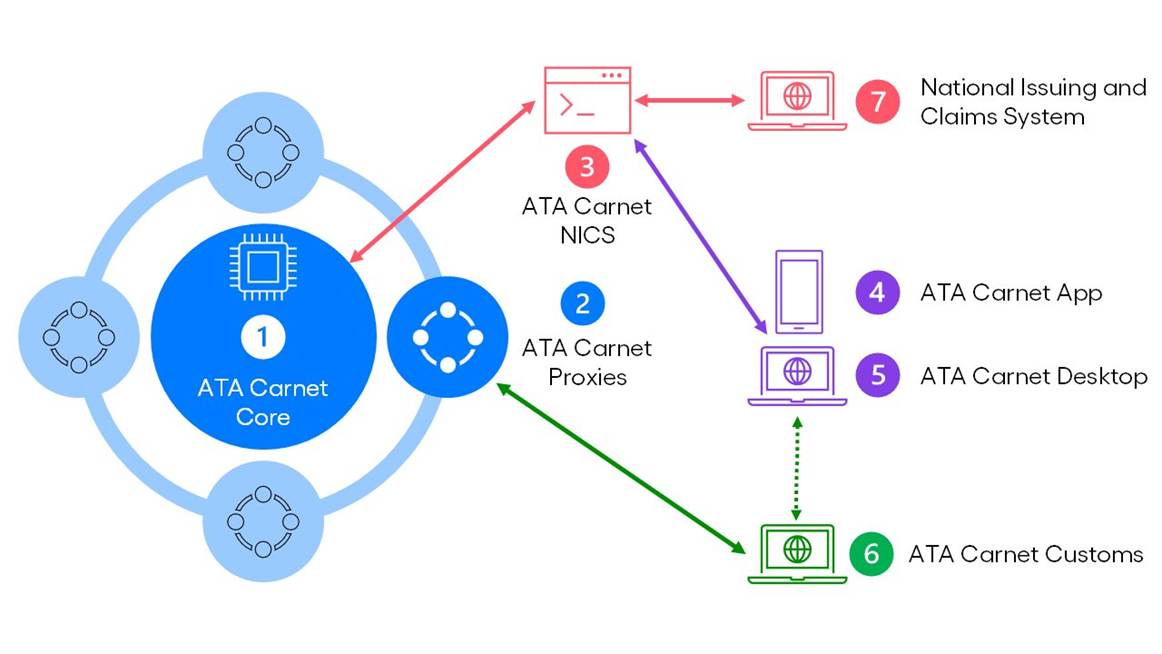
The ATA Carnet Core (Exhibit 1) is the central IT system that links the other parts together and ensures that the exchange mechanism is secure and robust. This component includes a user interface with various monitoring, reporting, alerting, and analytics tools developed to enable ICC to manage the eATA digital environment. NGAs/IAs may also have access to check statistics of their own.
ATA Carnet Proxies (Exhibit 2), technical components with no UI, strengthen the connection speed and enable each user to connect easily to the Core. ICC plans to deploy six proxies around the world. Each proxy will record a copy of all the eATA Carnets issued and can back up the other proxies in case of a technical failure.
The ATA Carnet NICS (Exhibit 3), also a technical component with no UI, provides an application programming interface (API) to enable each country to integrate its own national issuing and claims system (Exhibit 7) with the ATA Carnet Core. Six API bases have been built to cover the entire world. NGAs/IAs can integrate their systems via one of the six API bases.
The ATA Carnet App (Exhibit 4) is the mobile application provided to Carnet users (holders/representatives). It is a secure wallet where users can store the eATA Carnets purchased from an IA/NGA and prepare border crossing declarations via the app. Each user has a profile and can therefore access the system via any connected device. When an eATA Carnet is issued, users receive instructions on how to download it in the mobile application, and a QR code and a transaction code is created for each declaration. When crossing borders, users simply need to show Customs the QR code or the transaction code. Pre-arrival notices/declarations are also supported, an optional function activated only if required by Customs.
The ATA Carnet Desktop (Exhibit 5) is the desktop alternative to the ATA Carnet App. It was developed to enhance user experience, especially for holders/representatives managing large numbers of carnets and prefer not to use a mobile device.
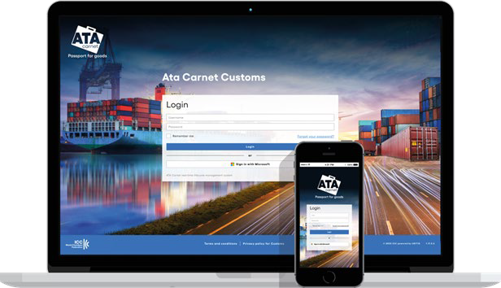
The ATA Carnet Customs portal (Exhibit 6) serves as the user interface designed specifically for Customs authorities. It offers both a single sign-on (SSO) API and a standard user interface, enabling the creation and management of accounts for Customs offices and officers, oversight of border crossing operations, and monitoring of the eATA Carnet lifecycle. Currently, Customs authorities are required to utilise the ICC’s standard user interface; integration with their own digital systems will be available subsequent to the global eATA transition and further API development.
The National Issuing and Claims Systems (NICS) (Exhibit 7) constitutes the digital tools developed by NGAs/IAs for integration with the ICC system. These NICS are not standardised, as each NGA/IA employs its own methods for managing issuance and claims processes. Through integration, however, data exchanged with the ICC’s ATA Carnet system is standardised.
The ATA Carnet system has also been assessed by an external company to verify its security. More assessments are planned in the future as the system evolves.
Comparison of ATA paper process and the full digital process
Below is a non-exhaustive list of practice comparisons between how the paper carnet is processed and how this will change with the digital carnet during the declaration and transaction process.
Paper process | Digital process |
Customs administrations authorise Customs offices and officials to handle ATA Carnets | Customs administrations create accounts for Customs offices and officials to enable them handling eATA Carnets |
Holder gets a paper carnet from an issuing association. | Holder gets an eATA ID and Pin from an issuing association and downloads the carnet data into his/her wallet. |
To prepare a declaration, the holder/representative fills in required fields in the paper voucher. | To prepare a declaration, the holder/representative types in required fields in the ATA Carnet App/Desktop. A transaction QR and a transaction code will be generated for each declaration, replacing the paper voucher. |
At the Customs border, the holder/representative presents the carnet voucher to the Customs official. | At the Customs border, the holder/representative presents the transaction QR or the transaction code to the Customs official. If Customs requires, the holder/representative can also make pre-arrival notification and declaration. |
The Customs official checks the data printed in the paper carnet. | The Customs official checks the data by scanning the transaction QR code or by typing in the transaction code, all data will be displayed in ATA Carnet Customs. If the pre-arrival notice/declaration function is enabled, the official will see carnet data directly in the system. |
The Customs official signs and detaches the paper voucher from the Carnet to record the transaction. | The Customs official digitally commits the transaction declared. The record is made automatically in ATA Carnet Customs. If needed, transactions recorded in the system can be exported. |
The customs officer signs the paper counterfoil and returns the paper carnet to the holder or representative so that they can verify the entry made by the officer. | Once a transaction is committed, a notification will be given automatically in the ATA Carnet App/Desktop so the holder/representative can verify the entry made by the Customs official. |
In case of error, modifications can be made with the consent of Customs. | In case of error, modifications can be made with the consent of Customs. To do so, the holder/representative shall provide a cancellation code to Customs, and then edit their declaration and redo the transaction. |
After transactions, vouchers will be manually matched in order to identify potential claims. In case of claims, the Customs administration notifies its guaranteeing association using its own way established with the NGA. | After transactions, Customs will check the transaction history recorded in ATA Carnet Customs. Thanks to the functionality of data reconciliation, it is much easier for Customs to identify potential claims. In case of claims, Customs administration notifies its guaranteeing association using its own way established with the NGA. |
With paper vouchers and counterfoils, Customs can handle special declaration and transaction processes, for example, making partial/split consignments, extending the final date of re-exportation/re-importation, using a replacement carnet, and terminating the temporary admission. | Using the transaction QR code and the ATA Carnet Customs system, customs officers can process special declarations and transactions. For full instructions, please refer to the Customs User Guide. |
How do ATA Carnet stakeholders go fully digital
Holders/representatives
Holders and representatives can download the ATA Carnet App from the App Store or Google Play Store or by downloading the APK file directly. Once the app is installed and an account is created, the user may download the digital carnet by inputting eATA ID and PIN as provided by the IA. Alternatively, representatives can also just receive a link from the holder to open and transact a single declaration without them having to download the ATA Carnet App and registering for an account. If using mobile application is not convenient, holders and representatives may use ATA Carnet Desktop, the web-based application.
NGAs/IAs
NGAs and IAs can digitise in two ways: if they already have a National Issuing and Claims System that qualifies for integration, they may continue to use their own software to issue carnets. By integrating, they will receive the eATA ID and PIN to be given to the holders.
Alternatively, should they not have a qualified National Issuing and Claims System or not have one at all, they may register to use a generic issuing platform (ICC ATA Gateway) directly. The ATA Gateway allows NAGs and their IAs to issue carnets and is already connected to the ATA Carnet System out of the box, no tweaking required.
Customs
Before the end of the eATA global transition, Customs are invited to use ATA Carnet Customs directly as it does not imply any costs or integration risks. The portal works directly from a web browser.
Currently, only SSO integration is available for Customs. Full integration between the ATA Carnet System and national Customs systems will only be possible after the end of the global transition. However Customs should not underestimate the cost for integration and possible long-term maintenance which must be done and covered by Customs administrations.
To help Customs administrations better prepare for the transition of ATA Carnet from a paper- based procedure to its digital era, an eATA Customs Preparation Guide was prepared by ICC. We strongly recommend each country/customs territory assign a project manager to coordinate internally and communicate externally, especially with ICC, and keep the preparation on track.
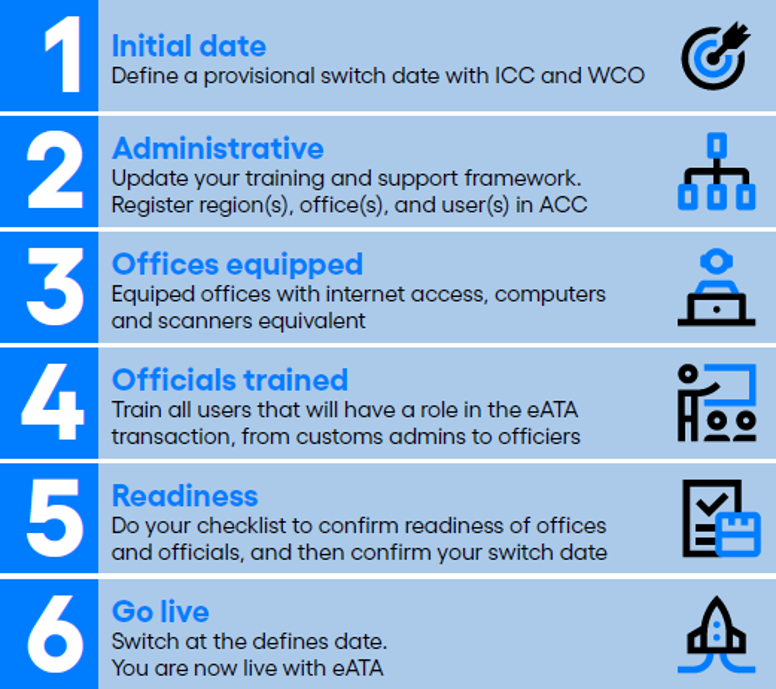
For details of the Customs Preparation Guide, please visit https://iccwbo.org/business-solutions/ata-carnet/eata-carnet/.
Assumptions of this paper
To elaborate the Global Transition Plan and go into detail in the pragmatic use cases, basic assumptions had to be made. These are listed as follows:
- All issuing associations are technically capable to issue paper carnet and digital carnet (eATA ID & pin code) from Q3 2023. A common strategy has been agreed by the issuing network in November 2021 that all ATA carnets issued after 01 January 2023 must have synchronous digital records in the global system deployed by ICC. Q1 and Q2 2023 are used as a buffer for the issuing network’s readiness.
- However, not all Customs will shift to eATA carnet procedures on the same date.
- Therefore, there will be “paper countries” and “digital countries” during the global transition period.
- “Paper countries” refer to Customs territories where declarations must be made with paper carnets.
- “Digital countries” refer to Customs territories where declarations must be made with digital carnet data and transactions are digitally committed using the eATA system as deployed by ICC.
- Digital countries should not be asked to process any paper carnets at all with the exception that they need to validate/activate paper carnets issued in their territories and process the exportation counterfoil, so that these paper carnets can be used in paper destinations. Processing paper carnets for re-importation is optional. (In other words, when any paper country is involved in temporary admission or transit, the digital country of export is expected to not only process the digital carnet for activation and exportation using the ATA Carnet Customs portal but also stamp the corresponding paper carnet’s green cover page and yellow export counterfoil. Then, at the time of re-importation, the digital country commits the re-importation transaction in the digital portal while stamping the paper carnet’s re-importation counterfoil is optional.) Borders are busy, if Customs officers and Carnet holders have to go through the paper procedure and the digital procedure in parallel for every single carnet, we would be concerned that Customs would take the digital procedure as extra work, and holders could blame eATA for making border transactions longer.
- Customs authorities in the country of issue do not need to check the destinations where the carnet will be used.
- Today, apart from validation/activation (certified by the Customs of departure in box H of the Cover page) and/or the export confirmation, Customs authorities in the country of temporary admission/transit do not rely on/abide by the entries made by other Customs (in the country of issue or in other countries) to grant the temporary admission/transit. This would avoid obligating digital countries to double their workload to handle both paper carnets and digital carnets except endorsing the cover page and the export counterfoil of the equivalent paper carnet to accommodate the need of paper countries. For digital countries, they would need to trust the validation/activation made by paper countries on the equivalent paper carnets instead of obligating paper countries to handle digital carnets that they are technically not ready yet.
- Each Contracting Party to the ATA Convention and/or Istanbul Convention shall notify WCO and ICC when it is ready to shift to the eATA carnet procedure, i.e. the digital date. Firstly, each Contracting Party shall notify a provisional digital date at least 5 months before the said date. Then each Contracting Party should confirm the digital date 3 months before such date using the standardised notification template approved by the WCO ATA/Istanbul Convention Administrative Committee. The 3 months would allow appropriate preparations from the user side. We expect Contracting Parties to one Customs Union to shift at the same time, and all offices in one Contracting Party are ready at the same time, i.e. not having paper offices and digital offices in one Contracting Party.
- Upon the receipt of the notification, WCO shall notify other Contracting Parties and ICC, and ICC shall notify the NGA/IA network with a list of digital countries and paper countries so that issuing associations must issue the right type of carnets according to the acceptance of the Customs administration(s) involved in the itinerary. The information will be published online and updated on a regular basis over the global transition period.
- With the lists, the following points are clear to each stakeholder:
- For holders: the right type of carnet format to use at home and abroad.
- For IAs: the right type of carnet formats to issue and deliver, and the impact of the transition on carnet discharge and claims.
- Actions to take when the carnet is returned.
- For Customs: actions to take at the border. And the impact of the transition on claims.
Different use cases during the transition phase
When the holder applies for a carnet, the holder should specify the destination countries. It will allow the issuing association to deliver the right type/format of carnets to be used in countries involved in the itinerary.
Below the different use cases are identified and further explained.
From To | Paper country(ies) | Digital country(ies) | Both |
Paper country | Use case 1 | Use case 2 | Use case 5 |
Digital country | Use case 4 | Use case 3 | Use case 6 |
Use case 1: from a paper country to paper country(ies)
When goods need to be moved from a paper country to another paper country or multiple paper countries, only a paper carnet will be issued and used.
Holder:
- Apply for a paper carnet, use it at home and abroad.
- When the temporary admission mission is finished, return the carnet back to the IA for discharge.
IA:
- Issue a paper carnet.
- Do not send the eATA ID & Pin to the holder even though they are displayed in the issuing system.
- When a carnet is returned, check transaction records in the paper carnet to discharge or maintain the security.
- In case of claims, work with NGA as per NGA’s instruction.
Customs of departure (paper country):
- Process the paper carnet as before.
Customs of temporary admission (paper country):
- Process the paper carnet and manage claims as before.
Explanatory examples: illustrating the format of carnets to use at borders.
Use Case 1: from a paper country to paper country(ies)
Country | Transactions | Carnet format |
Paper A | Activation | paper |
Paper A | Exportation | paper |
Paper B | Transit open | paper |
Paper B | Transit close | paper |
Paper C | Importation | paper |
Paper C | Re-exportation | paper |
Paper A | Re-importation | paper |
Use case 2: from a paper country to digital country(ies)
When goods need to be moved from a paper country to a digital country or multiple digital countries, the IA must issue a paper carnet and its digital version must also be delivered to the holder (by providing the holder with the eATA ID and pin). The paper carnet is used in the country of departure/export (paper country) and the digital carnet is used in the country of temporary admission or transit (digital country).
Holder:
- Apply for a paper carnet with its eATA ID & PIN.
- After the carnet has been issued by the IA, download the digital carnet (using the eATA ID/pin) into the ATA Carnet App/ATA Carnet Desktop.
- Use the paper carnet in the country of departure/export (paper country) for activation, exportation, and re-importation.
- Use the digital carnet in the country of temporary admission or transit (digital countries) for importation and re-exportation or transit open and transit close. It means that the holder shall prepare and submit declarations via the ATA Carnet App /Desktop in the digital countries. This would require all digital carnets to be automatically validated by the system. Should the digital countries require, holders may present the paper carnet’s cover page to demonstrate the validation/activation made in the country of departure/export (paper country).
- When the temporary admission mission is finished, notify the IA, and return the paper carnet back to the IA for discharge.
IA:
- A paper carnet should be issued along with an eATA ID and PIN. After the issuing data is confirmed, the eATA ID and PIN will appear in the issuing system. IA must deliver the paper carnet and its eATA ID/PIN to the holder, i.e. do not distribute the paper carnet unless the eATA ID and PIN have been generated.
- When the carnet is returned to the IA, the IA needs to check both paper transaction records and digital transaction records to discharge or maintain the security. If there are unused digital vouchers, block the carnet to avoid unauthorized usage after discharge.
- In case of claims, work with NGA as per NGA’s instruction.
Customs of departure (paper country):
Transactions related: activation, exportation, and re-importation
- Process the paper carnet.
Customs of temporary admission or transit (digital country):
Transactions related: importation and re-exportation; transit open and transit close
- Login to ATA Carnet Customs.
- Process the digital carnet for importation and re-exportation, or transit open and transit close. Note: the activation of this carnet was made in the country of departure (paper country) on the paper carnet.
- Officers in charge of claims may review transaction history using ATA Carnet Customs to determine if a claim is needed. Customs can access all previous international transactions before arrival, but not those made after—except for the final re-importation.
- If a claim is needed, open and manage the claim with your NGA as before.
- In terms of claims, you may receive evidence made in the paper country in the traditional format and/or evidence made in digital countries in the new eATA transaction format. For example, you may receive the traditional re-importation counterfoil, or a certificate of location issued in the country of departure (paper country), and you may also receive evidence made in another digital country demonstrating the digitally recorded subsequent transactions or a certificate of location. Evidence made in paper countries in the traditional format and/or evidence made in digital countries in the new eATA transaction format should be accepted by countries of temporary admission and transit as evidence.
Explanatory examples: illustrating the format of carnets to use at borders.
Use Case 2: from a paper country to digital country(ies)
Country | Transactions | Carnet format |
Paper A | Activation | paper |
Paper A | Exportation | paper |
Digital 1 | Transit open | eATA |
Digital 1 | Transit close | eATA |
Digital 2 | Importation | eATA |
Digital 2 | Re-exportation | eATA |
Paper A | Re-importation | paper |
Use case 3: from a digital country to digital country(ies)
When goods need to be moved from a digital country to another digital country or multiple digital countries, only a digital carnet will be issued and used.
Holder:
- Apply for a digital carnet.
- After the carnet has been issued by the IA, download the digital carnet (using the eATA ID/PIN provided by the IA) into the ATA Carnet App or ATA Carnet Desktop.
- Use the digital carnet for all transactions at home and abroad (since they are all digital countries). It means that the holder shall prepare and submit declarations via the ATA Carnet App/Desktop at all times.
- When all transactions are completed or the digital carnet will no longer be used, notify the IA for discharge.
IA:
- Once issuing data is validated, an eATA ID/PIN will be displayed on the issuing system side.
- IA shall deliver the eATA ID/PIN to the holder, and no paper carnet will be delivered since all countries in the itinerary are paper free.
- When the holder requests a discharge, IA needs to check digital transaction records to discharge or maintain the security. If there are unused digital vouchers, block the carnet to avoid unauthorized usage after discharge.
- In case of claims, work with NGA as per NGA’s instruction.
Customs of departure (digital country):
Transactions related: activation, exportation, and re-importation.
- Login to ATA Carnet Customs.
- Read carnet and declaration data by scanning the transaction QR code or typing in the transaction code.
- Commit the transaction using ATA Carnet Customs.
Customs of temporary admission or transit (digital country):
Transactions related: importation and re-exportation; transit open and transit close.
- Login to ATA Carnet Customs.
- Read carnet and declaration data by scanning the transaction QR code or typing in the transaction code.
- Commit the transaction using ATA Carnet Customs.
- Officers in charge of claims may review transaction history using ATA Carnet Customs to determine if a claim is needed. Customs can access all previous international transactions before arrival, but not those made after—except for the final re-importation.
- If a claim is needed, open and manage the claim with your NGA as before. Evidence demonstrating subsequent declarations digitally committed in another digital country should be accepted. Evidence outside the system shall also be recognised as long as they are certified by Customs.
Explanatory examples: illustrating the format of carnets to use at borders.
Use Case 3: from a digital country to digital country(ies)
Country | Transactions | Carnet format |
Digital 1 | Activation | eATA |
Digital 1 | Exportation | eATA |
Digital 2 | Transit open | eATA |
Digital 2 | Transit close | eATA |
Digital 3 | Importation | eATA |
Digital 3 | Re-exportation | eATA |
Digital 1 | Re-importation | eATA |
Use case 4: from a digital country to paper country(ies)
When goods need to be moved from a digital country to one or more paper countries, the IA must issue both a paper carnet and a digital version. Customs officials at the country of departure / export will need to activate and complete the export process for both the paper and digital carnets. For re-importation, digital countries will process the digital carnet, while processing the paper version becomes optional. In paper countries of the temporary admission or transit, Customs will handle the paper carnet.
Holder:
- Apply for a paper carnet with its eATA ID & PIN.
- After the carnet has been issued by the IA, download the digital carnet (using the eATA ID/pin) into the ATA Carnet App or ATA Carnet Desktop.
- Use the digital carnet for activation, exportation, and re-importation in the country of departure/export (digital country). At the time of departure/export, present also the paper carnet for activation and exportation, so that the paper carnet is recognised in other paper destinations. Presenting the paper carnet for re-importation is optional, depending on Customs’ requirements.
- Use the paper carnet in the country of temporary admission or transit (paper countries) for importation and re-exportation or transit open and transit close.
- When the temporary admission mission is finished, notify the IA, and return the paper carnet back to the IA for discharge.
IA:
- Once issuing data is validated, an eATA ID/PIN will be displayed on the issuing system side. IA must deliver paper carnet together with its eATA ID/PIN to the holder.
- When the carnet is returned to the IA, the IA needs to check both paper transaction records and digital transaction records to discharge or maintain the security. If there are unused digital vouchers, block the carnet to avoid unauthorized usage after discharge.
- In case of claims, work with NGA as per NGA’s instruction.
Customs of departure (digital country):
Transactions related: activation, exportation, and re-importation
- Process the digital carnet for activation, exportation, and re-importation .
- Process also the paper carnet for activation and exportation (stamping green cover and export counterfoil), so the paper carnet can be used in paper destinations.
- Processing the paper carnet for re-importation is optional.
Customs of temporary admission or transit (paper country):
Transactions related: importation and re-exportation; transit open and transit close
- Process the paper carnet as usual. In the paper carnet, you will see stamps on the green cover and the export counterfoil made by the country of departure/export. Paper carnets will not show other transactions made digitally in digital countries.
- In case of claims, evidence made in paper countries in the traditional format and/or evidence made in digital countries in the new eATA transaction format should be accepted by countries of temporary admission and transit as evidence.
Explanatory examples: illustrating the format of carnets to use at borders.
Use Case 4: from a digital country to paper country(ies)
Country | Transactions | Carnet Format Option 1 | Carnet Format Option 2 |
Digital 1 | Activation | eATA + paper | eATA + paper |
Digital 1 | Exportation | eATA + paper | eATA + paper |
Paper A | Transit open | paper | paper |
Paper A | Transit close | paper | paper |
Paper B | Importation | paper | paper |
Paper B | Re-exportation | paper | paper |
Digital 1 | Re-importation | eATA | eATA + paper |
Extended scenarios
The next two use cases involve a mix of different scenarios, but they operate on the same principles as User Case 2 and User Case 4.
Use case 5: from a paper country to both paper countries and digital countries (an extension of User case 2)
When goods need to be moved from a paper country to other paper countries and digital countries.
Holder
- Apply for a paper carnet with its eATA ID & PIN.
- After the carnet has been issued by the IA, download the digital carnet (using the eATA ID/pin) into the ATA Carnet App or ATA Carnet Desktop,
- Use the paper carnet in the country of departure/export (for activation, exportation, and re-importation) and in those paper destinations (for importation and re-exportation, or transit open and transit close).
- Use the digital carnet in digital destinations for importation and re-exportation or transit open and transit close. It means that the holder shall prepare and submit declarations via the ATA Carnet App or ATA Carnet Desktop in digital countries. This would require all digital carnets to be automatically validated by the system. Should the digital countries require, holders may present the paper carnet’s cover page to demonstrate the validation/activation made in the country of departure/export (paper country).
- When the temporary admission mission is finished, notify the IA, and return the paper carnet back to the IA for discharge.
IA
- A paper carnet should be issued along with an eATA ID and PIN. After the issuing data is confirmed, the eATA ID and PIN will appear in the issuing system. IA must deliver the paper carnet and its eATA ID/PIN to the holder, i.e. do not distribute the paper carnet unless the eATA ID and PIN have been generated.
- When the carnet is returned to the IA, the IA needs to check both paper transaction records and digital transaction records to discharge or maintain the security. If there are unused digital vouchers, block the carnet to avoid unauthorized usage after discharge.
- In case of claims, work with NGA as per NGA’s instruction.
Customs at departure (paper country)
- Process the paper carnet for activation, exportation, re-importation.
Customs of temporary admission or transit (paper country)
- Process the paper carnet for importation and re-exportation, or transit open and transit close.
- In case of claims, evidence made in paper countries in the traditional format and/or evidence made in digital countries in the new eATA transaction format should be accepted by countries of temporary admission and transit as evidence
Customs of temporary admission or transit (digital country)
- Process the digital carnet for importation and re-exportation, or transit open and transit close. Note: the activation of this carnet was made in the country of departure (paper country) on the paper carnet.
- Officers in charge of claims may review transaction history using ATA Carnet Customs to determine if a claim is needed. Customs can access all previous international transactions before arrival, but not those made after—except for the final re-importation.
- If a claim is needed, open and manage the claim with your NGA as before, Evidence made in paper countries in the traditional format and/or evidence made in digital countries in the new eATA transaction format should be accepted by countries of temporary admission and transit as evidence.
Explanatory examples: illustrating the format of carnets to use at borders.
Use Case 5: from a paper country to both paper and digital country(ies)
Country | Transactions | Carnet format |
Paper A | Activation | paper |
Paper A | Exportation | paper |
Digital 1 | Importation | eATA |
Digital 1 | Re-exportation | eATA |
Paper B | Transit open | paper |
Paper B | Transit close | paper |
Digital 2 | Importation | eATA |
Digital 2 | Re-exportation | eATA |
Paper A | Re-importation | paper |
Use case 6: from a digital country to both paper countries and digital countries (an extension of User case 4)
When goods need to be moved from a digital country to paper countries and other digital countries.
Holder
- Apply for a paper carnet with its eATA ID & PIN.
- After the carnet has been issued by the IA, download the digital carnet (using the eATA ID/pin) into the ATA Carnet App or ATA Carnet Desktop,
- Use the digital carnet for activation, exportation, and re-importation in the country of departure/export (digital country). At the time of departure/export, present also the paper carnet for activation and exportation, so that the paper carnet is recognised in other paper destinations. Presenting the paper carnet for re-importation is optional, depending on Customs’ requirements.
- Use the paper carnet in paper destinations for importation and re-exportation or transit open and transit close.
- Use the digital carnet in digital destinations for importation and re-exportation or transit open and transit close.
- When the temporary admission mission is finished, notify the IA, and return the paper carnet back to the IA for discharge.
IA
- Once issuing data is validated, an eATA ID/PIN will be displayed on the issuing system side. IA must deliver a paper carnet together with its eATA ID/PIN to the holder.
- When the carnet is returned to the IA, the IA needs to check both paper transaction records and digital transaction records to discharge or maintain the security. If there are unused digital vouchers, block the carnet to avoid unauthorized usage after discharge.
- In case of claims, work with NGA as per NGA’s instruction.
Customs at departure (digital country)
- Process the digital carnet for activation, exportation, and re-importation .
- Process also the paper carnet for activation and exportation (stamping green cover and export counterfoil), so the paper carnet can be used in paper destinations.
- Processing the paper carnet for re-importation is optional.
Customs of temporary admission or transit (paper country)
- Process the paper carnet for importation and re-exportation, or transit open and transit close.
- In case of claims, evidence made in paper countries in the traditional format and/or evidence made in digital countries in the new eATA transaction format should be accepted by countries of temporary admission and transit as evidence.
Customs of temporary admission or transit (digital country)
- Process the digital carnet for importation and re-exportation, or transit open and transit close.
- Officers in charge of claims may review transaction history using ATA Carnet Customs to determine if a claim is needed. Customs can access all previous international transactions before arrival, but not those made after—except for the final re-importation.
- If a claim is needed, open and manage the claim with your NGA as before, Evidence made in paper countries in the traditional format and/or evidence made in digital countries in the new eATA transaction format should be accepted by countries of temporary admission and transit as evidence.
Explanatory examples: illustrating the format of carnets to use at borders.
Use Case 6: from a digital country to both paper and digital country(ies)
Country | Transactions | Carnet Format Option 1 | Carnet Format Option 2 |
Digital 1 | Activation | eATA + paper | eATA + paper |
Digital 1 | Exportation | eATA + paper | eATA + paper |
Paper A | Importation | paper | paper |
Paper A | Re-exportation | paper | paper |
Digital 2 | Transit open | eATA | eATA |
Digital 2 | Transit close | eATA | eATA |
Paper B | Importation | paper | paper |
Paper B | Re-exportation | paper | paper |
Digital 1 | Re-importation | eATA | eATA + paper |
Principles towards the global transition
- Until a revised plan is published, the current version of the Global Transition Plan is considered a high-level guidance to Contracting Parties. Contracting Parties are invited to work closely with WCO and ICC to join the ATA Carnet System at an earlier phase, where feasible.
- The shift from paper procedure to digital procedure should not affect the use of paper carnets already issued before the shift. For carnets already issued in paper format before the digital date of the country of temporary admission or transit, these carnets can be used within their validity. If a paper carnet has been accepted, the re-exportation/re-importation should be done in paper format. If an original carnet was accepted in paper format, but the replacement carnet is to be issued after the digital date, the replacement carnet can be in digital format.
- Paper carnets can be used if digital carnets can’t be issued or the system is not available during the transition. Customs administrations are encouraged to accept paper ATA carnets until the end of the transition phase, i.e. 31 December 2027, when digital declaration, i.e. QR code, would not be available.
- During the transition period, evidence made in paper countries in the traditional format and/or evidence made in digital countries in the new eATA transaction format should be accepted by countries of temporary admission and transit as evidence. Evidence outside the carnet/system but certified by Customs administrations (such as a Certificate of location) may still be recognised as before.
Was this article helpful?
That’s Great!
Thank you for your feedback
Sorry! We couldn't be helpful
Thank you for your feedback
Feedback sent
We appreciate your effort and will try to fix the article